ForgeOps
Operate software inside customer environments — without standing access.
ForgeOps is a platform for policy-controlled delegated execution across cloud and customer environments. Humans, services, automation and AI can request bounded capabilities while customer-side execution, credentials and final authority remain explicitly controlled at the destination boundary.
ALLOW / ASK / DENY is one visible part of that model. The broader scope includes capability packaging and delivery, exact revision and target binding, placement, requester identity, approvals, customer-local execution, update and rollback, and evidence about what actually happened.
First impression
The idea in six frames.
ForgeOps in six frames
The problem today
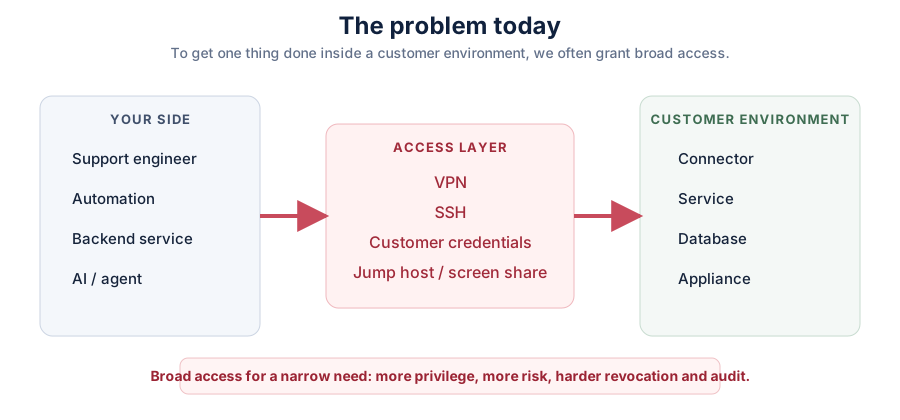
A narrow support or automation need often turns into broad standing access: VPN, SSH, shared credentials or an operator screen-share.
Platform scope
A governed execution layer, not only an approval screen.
The first public scenario is deliberately narrow because it makes the trust boundary easy to see. The engineering direction is broader: make software operations portable and governable across environments without turning remote connectivity or customer credentials into the product primitive.
Delegated execution
Turn operational intent into named, bounded capabilities instead of handing a requester a broad remote-access channel.
Cloud + customer edge
Coordinate from the platform while capability execution, target access and sensitive credentials can remain inside the customer environment.
Explicit authority
Requester identity and execution authority are separate. Policy and human approval can decide what may happen before an effect occurs.
Reusable capabilities
Package operations with declared inputs, targets, revisions and execution behavior so they can be delivered, bound and governed consistently.
Human, service and AI requesters
The same governed path can serve support engineers, backend services, automation and AI without silently widening what any requester may do.
Evidence and bounded effects
Treat the requested operation, decision, exact target, result and refusal as part of the execution record rather than relying only on after-the-fact remote-access logs.
A concrete policy example
ALLOW
Read diagnostics
A bounded read can run immediately when customer policy permits it.
ASK
Restart a connector
A consequential mutation can stop until a person on the customer side approves it.
DENY
Open a shell
A broad operation can be refused entirely, with no target effect.
Why it exists
A narrow operational need should not require broad standing access.
VPN, SSH, shared credentials, jump hosts and screen-sharing can solve connectivity, but they also grant a general path. ForgeOps explores a different primitive: ask for a named capability, bind it to the intended requester, revision and target, keep local authority at the destination, then return the result and evidence.
AI requester
AI can reason about what to do. It does not decide what it is allowed to do.
The model can diagnose symptoms and request an operation through the same path as any other caller. Changing the prompt does not widen customer policy, change capability bindings or let the model approve itself.
Current stage
Engineering-qualified, still looking for real operational validation.
The useful next signal is a real operation, inside a real customer boundary, where bounded delegated execution creates measurable value compared with the current access or support model.